 Retriever
A Paw alternative for Mac, and how to move in ten minutes.
Nokia discontinued RapidAPI for Mac, the app that used to be called Paw, in September 2026. It is not supported on macOS 27. It still opens today and will decay with each system update, so the time to export is now, while it runs.
Why Retriever
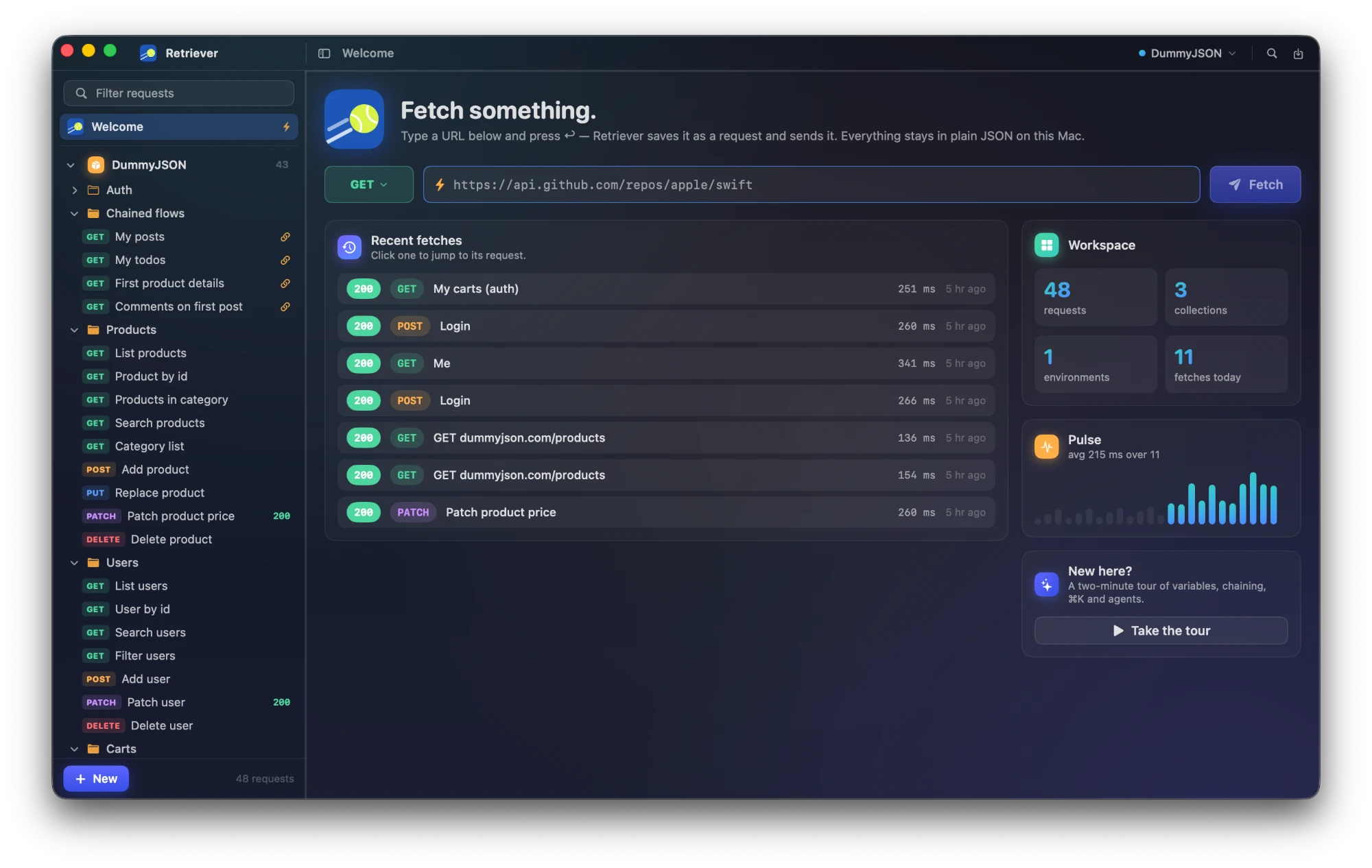
Paw was loved for three things: it was a real Mac app, your work lived in a file you owned, and you paid once. Most of what is left in the category is an Electron app that wants an account and a monthly seat. Retriever is built for the people Paw left behind: native Swift, plain JSON files on your disk, no account, one-time purchase. It adds what 2026 needs, including an MCP server so AI agents can drive your workspace.
1. Export from Paw
In RapidAPI for Mac choose File → Export → Postman Collection and pick version 2.1. Do this for each project. If you use environments, export those too: File → Export → Postman Environment.
Paw's own .paw project format is proprietary and undocumented, so Retriever does not read it. The Postman route preserves folders, requests, headers, bodies, query parameters, auth including OAuth 2 settings, and {{variables}}. Redirect URIs registered for Postman keep working, because Retriever can sign in through an in-app browser that stops at the redirect.
2. Import into Retriever
Press ⌘O, then paste the JSON or click Open File…. Collections appear in the sidebar. Imported environments become selectable from the toolbar. A collection variable named baseUrl becomes the collection's base URL automatically.
3. What maps to what
| In Paw | In Retriever |
|---|---|
| Project | Collection |
| Group | Folder |
| Environment domain and environments | Environments, one active at a time, switched from the toolbar |
| Environment variable | {{name}}, same syntax |
| Dynamic value: UUID | {{$uuid}} |
| Dynamic value: Timestamp | {{$timestamp}}, {{$timestampMs}}, {{$isoTimestamp}} |
| Dynamic value: Random | {{$randomInt(1,100)}}, {{$randomString(16)}} |
| Dynamic value: Base64 | {{$base64(text)}} |
| Response Parsed Body (chaining) | {{@Request Name.body.path.to.value}}. Right-click a value in a response and choose Copy as Chain Reference. |
| Response Header | {{@Request Name.header.Name}} |
| HTTP Basic, bearer tokens | Auth tab: Basic, Bearer or API key, or inherit the collection default |
| OAuth 2 (any grant) | Auth tab: OAuth 2.0. Authorization code with PKCE, client credentials, device code, password or refresh token, with automatic refresh |
| Code generator extensions | ⇧⌘C: cURL, Swift, JavaScript, Node.js, Python, Go, HTTPie |
What Retriever doesn't do yet
- A cookie jar
- Custom JavaScript dynamic values and Paw extensions
- GraphQL introspection, WebSockets, gRPC
Everything that is in: the full feature list. If one of these blocks your move, email me. The order of the roadmap is set by what migrating users run into first.
Get it
A one-time purchase: $19 at the early adopter price, $39 later. No subscription, no account. The license key arrives by email; download the app and paste it in.